Introduction
It’s one of the most common questions we get at The Logic Coffee:
“Should I buy a manual or automatic espresso machine?”
The honest answer? It depends entirely on who you are and what you want from your morning coffee ritual.
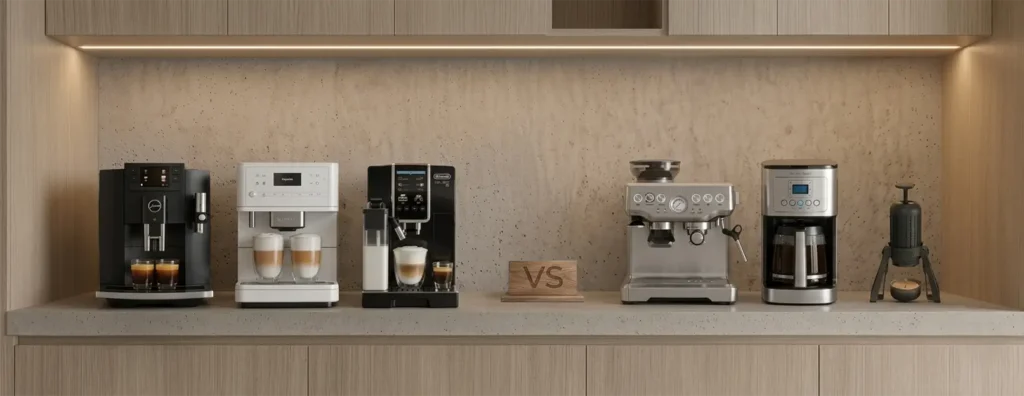
Manual machines promise full control and a deeply satisfying hands-on experience. Automatic machines promise perfect espresso at the push of a button. Both deliver excellent results — but for very different types of people.
In this guide, we’ll break down the real differences, the pros and cons of each, and help you figure out exactly which side of the fence you belong on.
What Do We Mean by “Manual” and “Automatic”?
First, let’s clarify the terminology, because it can get confusing.
Manual espresso machines require you to control most or all of the brewing process yourself — grinding, dosing, tamping, and in some cases, even generating the pressure by hand (lever machines).
Automatic espresso machines automate one or more of these steps. There are three sub-categories:
- Semi-automatic — you grind and tamp, the machine controls water pressure and flow
- Fully automatic — the machine grinds, tamps, brews, and stops automatically
- Super-automatic (Bean-to-Cup) — the machine does absolutely everything, including frothing milk
For simplicity, in this guide we’ll compare manual/semi-automatic (hands-on) vs fully automatic/super-automatic (hands-off).
The Case for Manual & Semi-Automatic Machines
You’re in Complete Control
Every variable is in your hands — grind size, dose weight, tamp pressure, extraction time. This means you can tweak and refine until you achieve exactly the espresso you want. No algorithm, no preset. Just you and the coffee.
The Learning Curve Becomes the Reward
Many semi-automatic users describe brewing as a daily ritual they genuinely look forward to. There’s real satisfaction in pulling a perfect shot after weeks of practice. It’s the difference between driving a manual car and an automatic — one is more involving, and for enthusiasts, that’s the point.
Better Espresso Potential (With Practice)
A skilled barista using a semi-automatic machine will consistently outperform any automatic machine. The ceiling is higher because you’re not limited by what an algorithm thinks is optimal.
Lower Price for Higher Quality Hardware
At the $300–$500 range, semi-automatic machines offer significantly better build quality — brass components, commercial portafilters, more stable boilers — compared to fully automatic machines at the same price.
Our top semi-automatic picks:
Best Overall: Breville Barista Express — integrated grinder, PID temperature control, and professional steam wand in one package. The ideal gateway into serious home espresso. Check Price on Amazon
Best Budget: Casabrews CM5418 — 20-bar pressure, compact design, and surprisingly capable for its price. Perfect for beginners who want to learn without overspending. Check Price on Amazon
Best Premium: Gaggia Classic Evo Pro — commercial-grade 58mm portafilter, heavy-duty stainless steel build, and a highly modifiable platform for true coffee enthusiasts. Check Price on Amazon
The Case for Fully Automatic Machines
One Button. Perfect Coffee. Every Time.
Roll out of bed, press a button, walk away with a perfectly extracted espresso or a silky latte. No grinding, no tamping, no technique required. For many people — especially on busy weekday mornings — this is exactly what they need.
Consistency is Unbeatable
Automatic machines eliminate human error entirely. Every shot is extracted at the same pressure, temperature, and time. If you value consistency above all else, no manual machine can compete.
Milk Drinks Without the Skill
Steaming milk properly on a manual machine takes weeks of practice. Automatic milk systems — like De’Longhi’s LatteCrema or Philips’ LatteGo — produce café-quality foam instantly, with zero technique required.
Ideal for Households and Offices
When multiple people with different coffee preferences need to use the same machine, automatic is the only sensible choice. Everyone gets their drink exactly how they like it, without having to learn anything.
Our top automatic picks:
Best Overall: Miele CM 6160 MilkPerfection — double-cup brewing, WiFi connectivity, and Miele’s legendary build quality. The ultimate luxury automatic machine.
Check Price on Amazon
Best Budget: Philips 3200 Series LatteGo — the easiest milk system on the market, five one-touch drinks, and an AquaClean filter that eliminates descaling for up to 5,000 cups.
Check Price on Amazon
Best Premium: Jura E8 Piano Black — 17 specialty drinks, P.E.P. extraction technology, and fully automated cleaning. The gold standard for home automatic machines.
Check Price on Amazon
Head-to-Head Comparison
| Manual / Semi-Auto | Fully Automatic | |
| Ease of use | Requires practice | Beginner-friendly |
| Coffee quality ceiling | Very high | High |
| Consistency | Depends on skill | Always consistent |
| Milk drinks | Requires technique | Fully automated |
| Price for quality | Better value | Higher cost |
| Morning speed | Slower | Very fast |
| Enjoyment of process | High | Low |
| Best for | Enthusiasts | Convenience seekers |
What About Manual Portable Machines?
A third category worth mentioning: hand-powered portable espresso makers. These use your own physical pressure to extract espresso — no electricity, no pumps, no automation whatsoever.
They’re not for everyone, but for travelers and minimalists, they’re remarkable devices.
Top picks:
WACACO Nanopresso — 18 bars of hand-generated pressure in a device that fits in your jacket pocket. Check Price on Amazon
Flair Espresso PRO 2 — a lever machine that delivers café-quality espresso with full pressure control, built-in gauge, and an all-metal brew path. Check Price on Amazon
So Which One Should You Choose?
Here’s our simple decision framework:
Choose Manual / Semi-Automatic if:
- You enjoy the process of making coffee, not just drinking it
- You want to develop real barista skills over time
- You mostly drink straight espresso or americano
- You have 5–10 minutes for your morning coffee routine
- You want the best possible espresso quality at a given price point
Choose Fully Automatic if:
- You want great coffee with minimal effort
- You drink a lot of milk-based drinks (lattes, cappuccinos)
- Multiple people in your household drink different coffee styles
- Speed and consistency matter more than craft
- You have under 2 minutes for your morning coffee
Choose Manual Portable if:
- You travel frequently
- You want espresso anywhere without electricity
- You’re on a tight budget but refuse to compromise on quality
Our Final Verdict
Neither manual nor automatic is objectively better — they serve fundamentally different needs.
If you’re a first-time buyer who just wants great coffee without the learning curve, start with the Philips 3200 LatteGo. If you’re someone who finds the idea of mastering espresso genuinely exciting, start with the De’Longhi Dedica Deluxe or Casabrews CM5418 and enjoy the journey.
The best espresso machine is the one you’ll actually use every single morning.
Explore Our Full Machine Guides
Ready to explore? → Bean-to-Cup Machines → Semi-Automatic Machines → Capsule & Pod Machines → Drip Coffee Makers → Manual & Portable Machines
Choosing the right mechanism is just one part of the puzzle. If you are starting from scratch, make sure to read our complete step-by-step walkthrough in How to Choose Your First Espresso Machine: A Complete Beginner’s Guide.
As an Amazon Associate, I earn from qualifying purchases. This means if you click a link and make a purchase, I may earn a small commission at no extra cost to you